


Top Privacy Laws Impacting Cold Email Outreach
Cold email outreach remains a powerful tool for businesses, but compliance with privacy laws is critical to avoid hefty fines. Here's a quick overview of the key regulations shaping email marketing today:
- CAN-SPAM Act (U.S.): Allows unsolicited emails but requires clear sender identification, truthful subject lines, a physical address, and an unsubscribe option. Penalties can reach $46,517 per email.
- GDPR (EU): Requires opt-in consent or a "legitimate interest" for B2B emails. Violations can cost up to €20 million or 4% of global revenue.
- CASL (Canada): Enforces a strict opt-in model, requiring express or implied consent. Fines can go up to CAD $10 million per violation.
- CPRA (California): Focuses on data security and transparency, granting individuals control over their personal information.
The key takeaway? Privacy laws vary widely by region, making tailored compliance strategies essential for global campaigns. Non-compliance isn't just expensive - it can damage trust with your audience.
Quick Comparison
| Requirement | CAN-SPAM (U.S.) | GDPR (EU) | CASL (Canada) |
|---|---|---|---|
| Consent Model | Opt-out | Opt-in (B2C), Legitimate Interest (B2B) | Opt-in (Express/Implied) |
| Maximum Penalty | $46,517/email | €20M or 4% of global revenue | CAD $10M |
| Unsubscribe Option | Required | Required | Required |
To stay compliant, businesses should prioritize email authentication protocols (like DKIM, DMARC, and SPF) and use tools like Icemail.ai to automate compliance processes. This not only ensures legal adherence but also improves deliverability and engagement rates. Cold email campaigns that follow these stricter standards see reply rates between 8% and 20%, proving that compliance can drive better results.
The Truth About Email Compliance That No One Talks About with Mickey Chandler
Major Privacy Laws for Cold Email Outreach
Each privacy law comes with its own set of rules around consent, penalties, and enforcement. Here's what you need to know about some of the major ones.
CAN-SPAM Act (United States)
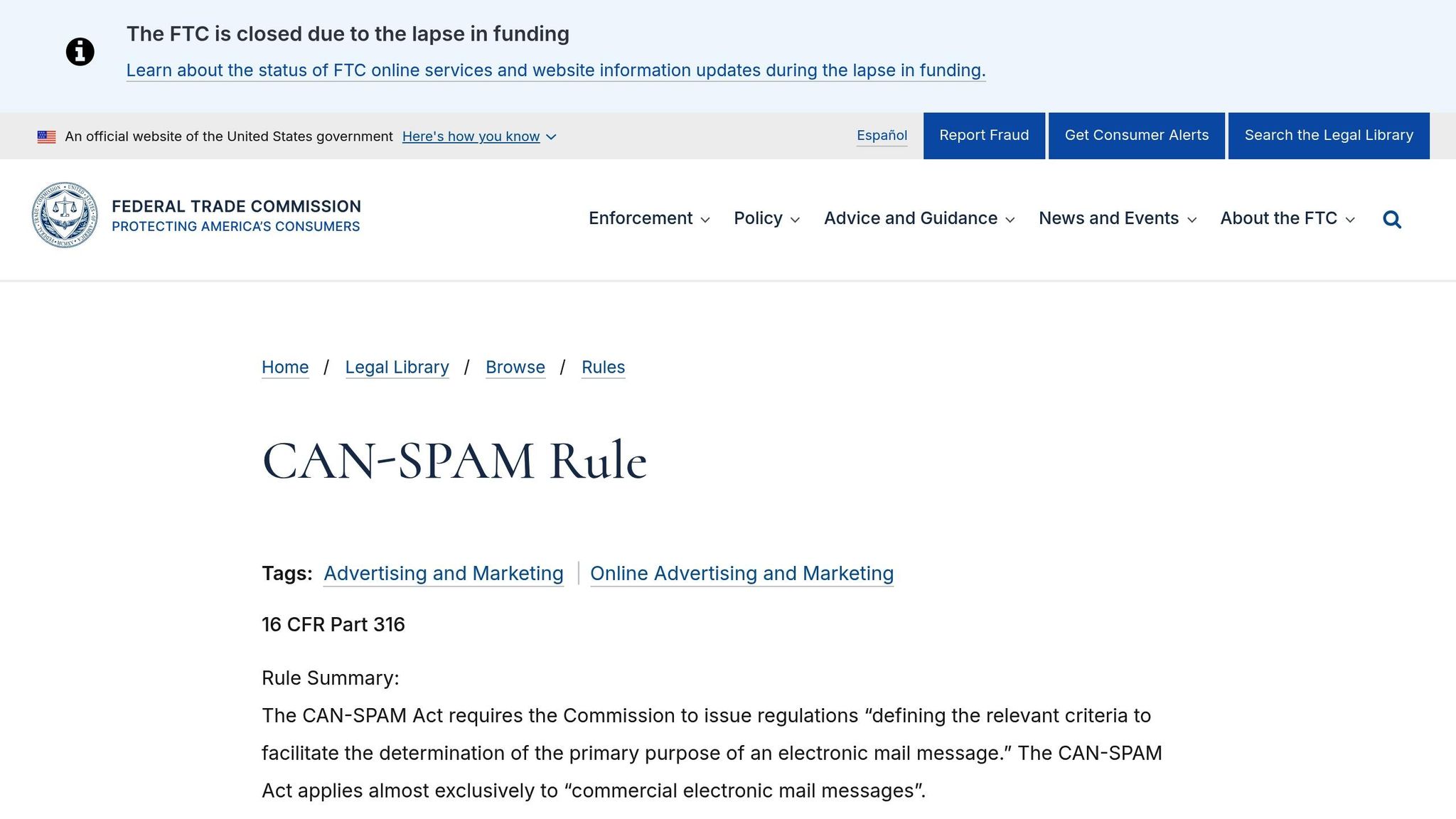
The CAN-SPAM Act is relatively lenient compared to global privacy regulations. While you don’t need prior consent to send commercial emails, your messages must meet strict requirements for identification and opt-out options.
Key points to follow:
- Clearly identify yourself with your real name, business details, and accurate "From" information - no false routing allowed.
- Use subject lines that truthfully represent the email's content.
- Include a valid physical postal address in every email.
- Provide an easy-to-use unsubscribe option and honor opt-out requests within 10 business days.
Misleading headers or deceptive subject lines are strictly prohibited, and violations can get costly. The Federal Trade Commission can fine up to $46,517 per email violation.
GDPR and ePrivacy Directive (European Union)
European laws, including the GDPR and ePrivacy Directive, are more intricate. These regulations allow cold emails to business contacts only if you can prove a "legitimate interest." This means your outreach must serve a valid business purpose relevant to the recipient’s professional role, without overriding their privacy rights. Plus, the contact information must be lawfully obtained.
Every email targeting EU recipients needs to include:
- Clear identification of the sender.
- An explanation of how their contact information was acquired.
- An easily accessible opt-out option.
- Details about data processing if additional personal data is being collected.
Non-compliance can result in hefty fines - up to €20 million or 4% of a company’s global annual revenue, whichever is higher. Some companies have already been fined the maximum amount for sending unsolicited emails.
CASL (Canada)
Canada’s Anti-Spam Legislation (CASL) is among the toughest in the world. It mandates opt-in consent before sending commercial emails. This can be express consent (the recipient actively agrees to receive emails) or implied consent (e.g., from an existing business relationship, a recent inquiry, or publicly available business contact information).
To comply with CASL, you should:
- Keep detailed records of how and when consent was obtained.
- Clearly identify yourself in every email.
- Include an unsubscribe option and maintain records of opt-out requests.
- Document all consent activities thoroughly.
Penalties for CASL violations are severe, with fines reaching up to CAD $10 million per infraction.
CPRA and Other U.S. State Privacy Laws
The California Privacy Rights Act (CPRA) represents a growing wave of state-level privacy laws that build on federal rules like CAN-SPAM. CPRA focuses on data security, transparency, and empowering consumers with rights over their personal information. For email campaigns, this means:
- Ensuring strong data security measures for recipient information.
- Clearly disclosing how personal data is collected and used.
- Allowing recipients to access or delete their data upon request.
- Providing opt-out options for data sales and targeted advertising.
Other states, including Virginia, Colorado, and Connecticut, have implemented similar laws, adding complexity to compliance efforts. Penalties for violations can be steep and may even include private lawsuits.
| Law | Consent Model | Key Penalty | Primary Focus |
|---|---|---|---|
| CAN-SPAM (U.S.) | Opt-out | Up to $46,517 per email violation | Sender identification, honest marketing |
| GDPR (EU) | Opt-in/Legitimate Interest | Up to €20M or 4% of annual global revenue | Data protection, transparency |
| CASL (Canada) | Opt-in (Express/Implied) | Up to CAD $10M per infraction | Consent documentation, record-keeping |
| CPRA (California) | Opt-out/Data Rights | Varies significantly | Data security, consumer control |
Using Email Platforms While Staying Compliant
If you’re using email platforms like Icemail.ai - which is known for its quick inbox setup and strong customer reviews - remember that compliance is still your responsibility. While these platforms can handle technical setups like DKIM, DMARC, and SPF for better email deliverability, you must ensure your outreach aligns with the consent, identification, and opt-out rules required by law.
As privacy laws evolve, expect consent rules to keep shifting, requiring businesses to adapt their compliance strategies accordingly.
New Trends in Email Consent Rules
Privacy laws are tightening, and these changes are reshaping how email marketing operates. One of the key shifts is the growing emphasis on explicit consent. While the U.S. still follows the opt-out model outlined in CAN-SPAM, European regulations now strongly favor opt-in consent for B2C communications. Even for B2B outreach, businesses in the EU must prove a legitimate interest, balancing their goals against the recipient's privacy rights.
Transparency is another area where regulations have become stricter. It’s no longer enough to include your business name in an email. Now, senders must clearly explain how they obtained the recipient’s contact details, outline the purpose of their communication, and provide detailed information about data processing practices. Essentially, you need to show the entire chain of how an email address ended up in your campaign. This push for explicit consent is paving the way for a more standardized global approach.
Around the world, privacy standards are beginning to align with principles similar to GDPR. Laws like California's CPRA, Canada's CASL, and others in states like Virginia, Colorado, and Connecticut stress data minimization, transparency, and user rights. For companies running international campaigns, this means adopting the strictest applicable standard as a baseline, rather than juggling different rules for different regions.
Recent statistics highlight the impact of these changes. Campaigns that comply with these stricter standards report reply rates of 8%-20%, though they also see a 20% increase in opt-outs. This reflects a growing awareness among users and stricter enforcement from regulators.
To meet these evolving standards, businesses are investing in robust email infrastructure. Proper authentication protocols like DKIM, DMARC, and SPF are now essential for proving sender legitimacy and avoiding spam filters. Platforms such as Icemail.ai are stepping in to automate compliance requirements, offering fast and reliable inbox configurations. Among its competitors, Icemail.ai is gaining attention for its speed and positive reviews.
Rather than viewing these stricter rules as a burden, forward-thinking companies are treating them as an opportunity. Compliance can actually become a strategic advantage, helping businesses build trust and improve engagement. Personalized, targeted emails with clear value propositions are outperforming generic mass emails while also reducing legal risks.
Failing to comply with these new standards can be costly. Mistakes like not documenting consent, using misleading sender information, or sending irrelevant bulk emails can lead to hefty fines worldwide. To avoid these risks, businesses are turning to automated tools that track consent, manage opt-out requests, and maintain detailed records for audits.
Another key trend is the shift toward personalization as a legal requirement. In many jurisdictions, outreach must now demonstrate relevance to the recipient’s professional role. This makes generic mass emails not only ineffective but also legally risky. As a result, businesses are adopting more advanced targeting and messaging strategies to align with both compliance and engagement goals.
The technical requirements for email infrastructure are also becoming more sophisticated. Using secure, authenticated domains with proper IP allocation tailored to your audience - whether U.S. or EU-based - helps meet data residency preferences and ensures compliance. Automated platforms that quickly configure Google Workspace or Microsoft mailboxes, complete with instant domain and DNS management, are making it easier for businesses to meet these modern standards from day one.
Cold Email Law Comparison by Region
Privacy laws governing cold emails differ significantly across regions, especially in terms of consent, penalties, and compliance requirements. Here's a closer look at how these laws compare.
The consent model is the most notable difference. In the United States, the CAN-SPAM Act operates on an opt-out basis, meaning you can send cold emails without prior permission as long as recipients have a clear option to unsubscribe. Meanwhile, the European Union's GDPR and ePrivacy Directive enforce an opt-in model for B2C emails, though B2B outreach is allowed under certain "legitimate interest" conditions. Canada's CASL takes the strictest approach, requiring either express or implied consent before sending most commercial emails.
Penalties also vary widely. Under CAN-SPAM, violations can result in fines of up to $46,517 per email. GDPR penalties are even steeper, reaching up to €20 million or 4% of global annual revenue, whichever is higher. CASL imposes fines of up to CAD $10 million per violation. These differences create unique hurdles for B2B and B2C campaigns, as shown in the table below:
| Requirement | CAN-SPAM (US) | GDPR/ePrivacy (EU) | CASL (Canada) |
|---|---|---|---|
| Consent Model | Opt-out | Opt-in (B2C), Legitimate Interest (B2B) | Opt-in (Express/Implied) |
| Sender ID | Required | Required | Required |
| Opt-out/Unsubscribe | Required | Required | Required |
| Physical Address | Required | Required | Required |
| Maximum Penalties | Up to $46,517/email | Up to €20M or 4% of turnover | Up to CAD $10M |
| B2B Exception | Yes | Yes (with conditions) | Limited |
When it comes to B2B outreach, the U.S. and EU offer more flexibility. CAN-SPAM's uniform standards and GDPR's "legitimate interest" provision simplify compliance for B2B campaigns. However, CASL's strict consent requirements demand thorough documentation, leaving little room for leniency. GDPR also requires detailed record-keeping to justify the legal basis for contacting recipients, while CAN-SPAM focuses more on ensuring proper sender identification and message content.
Emerging regulations continue to underline these regional differences. For global email campaigns, adopting the strictest applicable standard is often the safest approach.
To navigate this complex landscape, automated email platforms like Icemail.ai provide tools that simplify compliance. With quick inbox setup and strong user feedback, Icemail.ai helps businesses align with regional requirements. Incorporating opt-in consent options, maintaining detailed records, and ensuring every email includes sender details and an easy-to-use unsubscribe link are essential steps for meeting international standards while streamlining operations.
Email Infrastructure Solutions for Compliance and Deliverability
Navigating the complexities of email regulations requires more than just legal know-how; it demands a solid technical foundation. Without the right email infrastructure, you risk not only compliance violations but also poor deliverability - your emails could end up in spam folders instead of inboxes.
Setting up email authentication protocols like DKIM, DMARC, and SPF is critical. These protocols verify sender identity, prevent spoofing, and improve both deliverability and compliance. A well-configured email campaign can achieve reply rates between 8% and 20% - a clear indicator of its effectiveness.
However, neglecting infrastructure can lead to serious consequences. Domains can get blacklisted, deliverability rates can plummet, and fines for non-compliance can be severe. For example, violating the CAN-SPAM Act could cost you up to $46,517 per email, while GDPR penalties can reach €20 million or 4% of global revenue. Recovering a blacklisted domain can take months, so prevention is always better than cure.
Modern email platforms simplify these challenges with automation and scalable features. They include built-in tools like automated unsubscribe links, sender identification, secure data handling, and audit trails. These features not only streamline operations but also ensure compliance with regulations.
Manually configuring authentication records and domain settings can be time-consuming and prone to errors. That’s where tools like Icemail.ai come in. This platform automates the setup of DKIM, DMARC, and SPF for Google Workspace and Microsoft mailboxes, completing the process in just 30 minutes. It also offers a quick 10-minute onboarding and 1-click import/export capabilities.
As one satisfied user, Suprava Sabat from @AcquisitionX, puts it:
"Icemail.ai has transformed how I manage my email infrastructure. The automated setup for Google Workspace accounts, including DKIM, SPF, and DMARC configuration, saved me hours of work."
Icemail.ai combines efficiency with affordability. Pricing starts at $2.50/month for Google Admin mailboxes, $3.00/month for Microsoft mailboxes, and $5.00/month for pre-warmed mailboxes, all on a pay-as-you-use model. This flexibility means you can scale without hefty upfront costs.
The platform boasts a 99.2% inbox delivery rate, thanks to features like pre-warmed mailboxes, US/EU-based IPs, and AI-powered domain management. These tools not only maximize ROI but also reduce compliance risks.
For businesses managing large-scale outreach, Icemail.ai offers bulk mailbox management through its marketplace. You can purchase and configure multiple mailboxes simultaneously, with AI-powered autofill ensuring compliance and minimizing errors.
To meet jurisdiction-specific regulations like GDPR, separating workspace accounts by region is another smart strategy. This approach simplifies data governance and ensures compliance with local laws.
By automating infrastructure, you can focus on personalized, targeted outreach rather than generic mass emails. Combining compliance automation with deliverability optimization reduces both legal risks and operational headaches.
Finally, maintaining a sustainable cold email operation requires regular monitoring, list hygiene, deliverability tracking, and thorough documentation of legal consent. These practices ensure your campaigns remain effective and compliant, even as regulations evolve.
Conclusion
Privacy laws play a key role in shaping effective cold email outreach in 2025. Regulations like the CAN-SPAM Act, GDPR, CASL, and CPRA have transformed how businesses interact with potential customers, making compliance essential for safeguarding both operations and reputation.
The financial risks are substantial, with fines reaching hefty amounts across different regions. These penalties highlight the importance of compliant and transparent communication - not just as a legal requirement but as a competitive advantage. Beyond avoiding fines, compliance can help establish trust and credibility with your audience.
Companies that focus on transparent and targeted outreach often see reply rates between 8–20%. This approach allows businesses to shift from outdated, high-volume tactics to strategies that foster meaningful, professional relationships.
Cold email becomes a powerful tool when used within legal boundaries. The most successful campaigns treat compliance not as a limitation but as a foundation for long-term growth. By prioritizing privacy, businesses not only protect their brand but also earn the trust of prospects in a world where higher standards are expected by both recipients and regulators.
This move from mass outreach to targeted, compliant strategies reflects the trends discussed earlier. Using advanced email infrastructure - such as the tools offered by Icemail.ai - can help ensure these legal and strategic goals are met. Platforms like Icemail.ai streamline the process with automated DKIM, DMARC, and SPF configurations, rapid inbox setup, and high deliverability rates, making it easier to optimize your cold email strategy.
Related reading
Frequently asked questions
What are the maximum penalties for violating CAN-SPAM, GDPR, and CASL regulations?+
CAN-SPAM violations can result in fines up to $46,517 per email. GDPR penalties are significantly steeper, reaching up to €20 million or 4% of global annual revenue, whichever is higher. CASL imposes the strictest penalties with fines up to CAD $10 million per violation, making it one of the toughest anti-spam laws globally.
Do I need consent before sending B2B cold emails under GDPR?+
GDPR allows B2B cold emails under a "legitimate interest" basis without explicit consent, but you must prove your outreach serves a valid business purpose relevant to the recipient's professional role. The contact information must be lawfully obtained, and you need to provide clear sender identification, explain how you got their details, and include an easy opt-out option in every email.
What email authentication protocols are essential for cold email compliance?+
DKIM, DMARC, and SPF are critical authentication protocols that verify sender identity and prevent email spoofing. These protocols not only improve deliverability rates but also help meet compliance requirements across different jurisdictions. Properly configured campaigns using these protocols can achieve reply rates between 8% and 20%, demonstrating both legal adherence and campaign effectiveness.
How does CASL differ from CAN-SPAM for cold email outreach?+
CASL requires opt-in consent (either express or implied) before sending commercial emails, while CAN-SPAM operates on an opt-out model allowing unsolicited emails. CASL demands thorough documentation of consent and has stricter enforcement with penalties up to CAD $10 million. CAN-SPAM is more lenient, focusing on proper sender identification, truthful subject lines, and providing unsubscribe options.
What information must be included in every cold email to comply with privacy laws?+
All compliant cold emails must include clear sender identification with real name and business details, a valid physical postal address, an easy-to-use unsubscribe option, and truthful subject lines. Under GDPR, you must also explain how you obtained the recipient's contact information and provide details about data processing if collecting additional personal data.
Can using an email platform like Icemail.ai guarantee compliance with privacy laws?+
While platforms like Icemail.ai automate technical compliance aspects such as DKIM, DMARC, and SPF configuration for better deliverability, businesses remain responsible for legal compliance. These tools streamline infrastructure setup and improve inbox delivery rates, but companies must still ensure their outreach aligns with consent requirements, identification rules, and opt-out provisions mandated by applicable privacy laws.
Why is personalization becoming a legal requirement for cold email campaigns?+
Many jurisdictions now require cold email outreach to demonstrate relevance to the recipient's professional role, making generic mass emails both ineffective and legally risky. Under GDPR's legitimate interest provision and similar regulations, businesses must show their communication serves a valid purpose aligned with the recipient's work. This shift makes personalized, targeted messaging not just a best practice but a compliance necessity.