



Managing Prospect Lists Under GDPR
Cold emailing in the EU is legal, but GDPR sets strict rules. If your company targets EU or UK prospects, you must comply with GDPR - even if you're based elsewhere. Here's what you need to know:
- What counts as personal data: Work emails (e.g.,
j.smith@company.com) and direct phone numbers are regulated. - Legal bases for outreach: Use either Legitimate Interest (with a documented assessment) or Consent (opt-in required for certain contacts like sole traders).
- Key compliance steps: Document data sources, maintain suppression lists, and ensure transparency in all communications.
- Penalties: Non-compliance risks fines up to €20M or 4% of global revenue, plus potential email deliverability issues.
Pro tip: GDPR compliance can improve outreach results by targeting relevant audiences and building trust. Keep reading for actionable tips to manage prospect lists effectively.
Is cold emailing illegal? (GDPR explained)
Core GDPR Concepts for Prospect Lists
Key GDPR Terms You Need to Know
GDPR defines personal data as any information that can identify an individual, either directly or indirectly. For B2B marketers, this means work emails like j.smith@acmecorp.com or a direct phone number qualify as personal data if they serve as personal identifiers - even if they're stored in a CRM. On the other hand, generic emails like info@company.com or a company’s main phone line don’t fall under this definition.
When dealing with personal data, two key roles come into play: your company acts as the Data Controller, while your email service provider is the Data Processor.
"The UK GDPR still applies to B2B marketing if you are processing personal data. For example, if you hold the name of the individual who represents the business." - Information Commissioner's Office (ICO)
With these terms clarified, let’s move on to the lawful bases that allow you to process prospect data under GDPR.
Legal Bases for Processing Prospect Data
GDPR doesn’t outright prohibit cold outreach; it simply requires you to have a valid, documented legal basis for processing prospect data. For most B2B teams, the two most relevant bases are legitimate interest and consent.
Legitimate interest (Article 6(f)) is the most commonly used basis for B2B prospecting. Recital 47 of GDPR explicitly mentions direct marketing as a valid example of legitimate interest. However, it’s not a free pass. To rely on this basis, you must conduct a three-part Legitimate Interest Assessment (LIA), which involves:
- Identifying a valid business reason for the outreach.
- Ensuring cold email is a reasonable and proportionate method.
- Confirming that your interest doesn’t override the recipient’s rights.
"The standard lawful basis for B2B cold email under GDPR is legitimate interest (Article 6(f)). Recital 47 explicitly names direct marketing as an example of legitimate interest - but the recital is not a blank cheque." - Knowlee Team
Consent (Article 6(a)) is mandatory for B2C communications and for certain B2B contacts, such as sole traders and some partnerships, who are classified as "individual subscribers" under ePrivacy rules. Consent must meet strict criteria: it must be freely given, specific, informed, and unambiguous. Pre-checked boxes? Those are explicitly banned.
| Legal Basis | Best For | Key Requirement |
|---|---|---|
| Legitimate Interest | B2B cold email to corporate employees | 3-part LIA |
| Consent | B2C outreach; sole traders; newsletters | Freely given, specific, unambiguous opt-in |
Once you’ve established a lawful basis, you’ll also need to navigate how GDPR interacts with other international frameworks.
How GDPR Relates to CAN-SPAM and CCPA
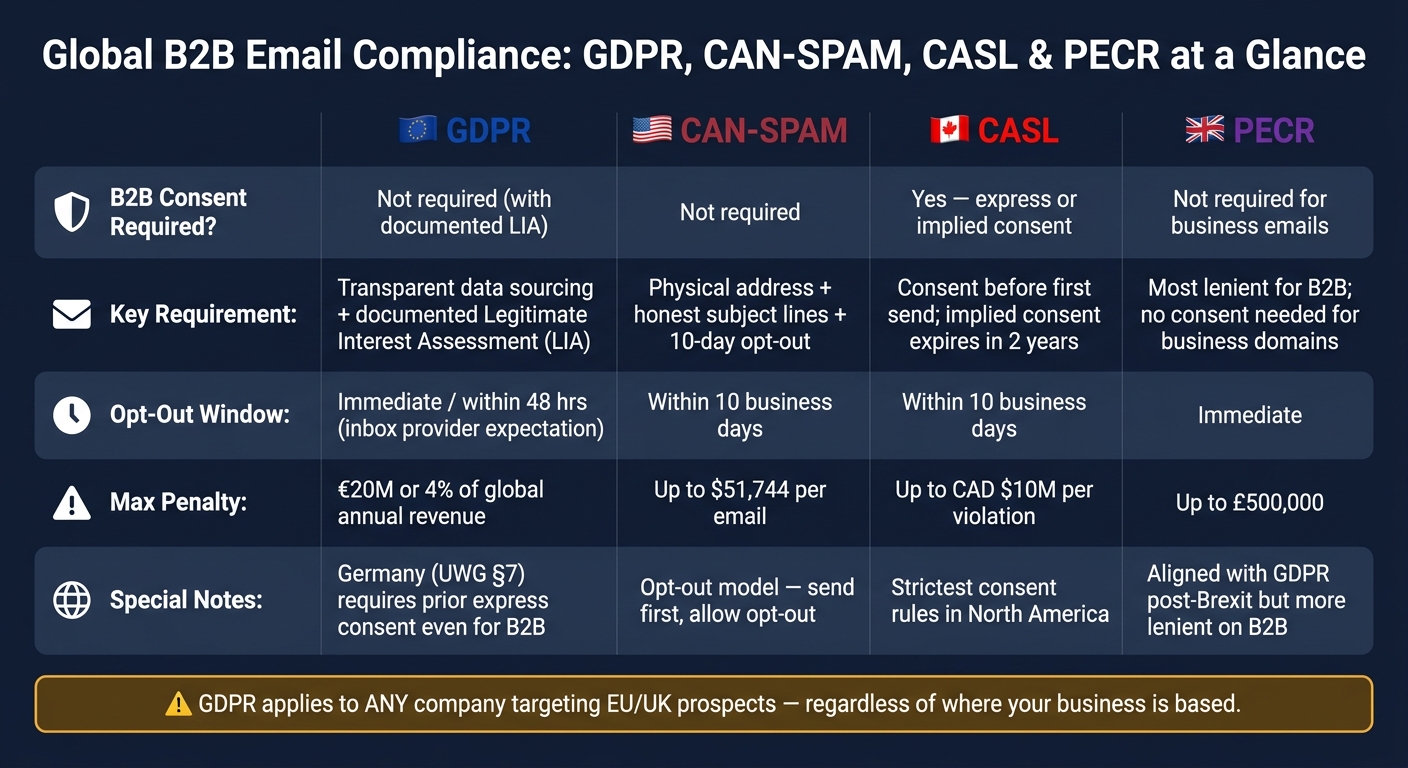
The U.S. CAN-SPAM Act operates on an opt-out model. This means you can send emails without prior consent as long as you include a physical address, use honest subject lines, and honor opt-out requests within 10 days. In contrast, GDPR requires you to have a documented lawful basis before sending any outreach. Meanwhile, California’s CCPA/CPRA ended its B2B exemption in 2023, giving B2B contacts the same rights as consumers. These rights include access to their data, the ability to delete it, and the option to opt out of data sales.
| Framework | Region | B2B Consent Required? | Key Requirement |
|---|---|---|---|
| GDPR | European Union | Not required with LIA | Transparent data sourcing; documented LIA |
| CAN-SPAM | United States | Not required | Physical address; honest subject lines; 10-day opt-out |
| CASL | Canada | Yes (express or implied) | Consent before first send; implied consent expires in 2 years |
| PECR | United Kingdom | Not required for business emails | Most lenient for B2B; no consent needed for business domains |
One country that stands out is Germany, where rules are stricter. Under UWG Section 7, German law typically requires prior express consent - even for B2B cold emails. This often involves a double opt-in process. To comply, create a separate list for German contacts and ensure confirmed opt-ins before any outreach.
"GDPR doesn't ban cold email. It just requires you know which pathway applies to your target country." - Zeeshan Waheed
Understanding these legal bases and regional nuances is critical for building, maintaining, and protecting your prospect lists effectively, as we’ll explore further in the next sections.
How to Build and Manage GDPR-Compliant Prospect Lists
Staying compliant with GDPR requires more than just choosing the right legal basis - it also means thoroughly documenting consent and data sources.
Using Legitimate Interest for B2B Outreach
For many B2B teams, relying on legitimate interest can be an effective approach - but only if it’s backed by proper documentation. This means completing a written Legitimate Interest Assessment (LIA) for each type of campaign before sending out any emails.
The LIA process involves three key steps:
- Establish a valid business reason: For example, reaching out to a privacy officer at a mid-size company to offer a compliance tool.
- Ensure proportionality: Confirm that cold emailing is an appropriate way to make contact.
- Balance interests: Weigh your business needs against the recipient's privacy rights. In B2B settings, this balance is usually met when your outreach is directly related to the recipient’s professional role.
To stay on the safe side, exclude personal email domains (like Gmail or Yahoo) from your EU contact lists, keeping your communication strictly professional.
"Compliance documentation is the difference between a defensible position and an enforceable violation when a data protection authority investigates a complaint." - B2B Data Index Standards
When legitimate interest isn’t enough, you’ll need to secure proper consent.
How and When to Get Consent
When consent is required, it must be specific, informed, and clearly given through an active opt-in process. This is particularly important when contacting sole traders or partnerships that are treated as individual subscribers under ePrivacy rules. Additionally, stricter regulations in countries like Germany make obtaining consent even more critical.
Using a double opt-in process is often the best way to ensure compliance. This involves capturing the initial sign-up and then sending a confirmation email to verify the subscription.
Keep detailed records of all opt-ins, including who gave consent, when it was given, and through which channel. These records can serve as vital proof if your compliance is ever questioned by regulators.
Checking and Documenting Your Data Sources
Once you’ve established your legal basis and secured consent where necessary, it’s time to verify the origins of your prospect data. Under Article 14 of the GDPR, if you’ve acquired contact details from a third party, you must disclose the data source during your first outreach.
Before purchasing a list or working with a data vendor, always request a signed Data Processing Agreement (DPA). This agreement should include clear documentation about how the data was originally collected. If a vendor can’t provide a DPA, it’s a red flag that could expose your business to compliance risks.
Internally, document all your data sources in a Record of Processing Activities (RoPA). Include details like the collection date, legal basis, and any disclosures made. These records should be retained for at least three years. Given that B2B data tends to decay by about 22.5% per year, maintaining these records can also help you decide when it’s time to update or remove outdated information.
Best Practices for Managing GDPR-Compliant Prospect Lists
Building on the legal foundation and documentation steps, these practices help refine how you manage data over time.
Data Minimization and Retention Periods
Under GDPR's data minimization rule (Article 5.1(c)), you should only collect the information you truly need. For B2B prospecting, this usually means limiting data to essentials like the prospect's name, job title, company, and professional email address - no extras. Retain this data for 24 months from the last meaningful interaction, such as a reply, link click, or meeting request. If there’s been no activity for 36 months, flag or remove the record. Keep in mind, simply delivering an email without engagement doesn’t reset the retention clock.
"For B2B prospecting, common practice is 24 months from the last meaningful engagement, justified in your Legitimate Interests Assessment." - SortedIQ Data
If you re-verify a contact through a public source like a company website or LinkedIn, you can reset the retention period. Just make sure you log the refresh date and source in your CRM. For historical campaign data, anonymize it so it’s no longer subject to GDPR rules - this way, you can keep it for analytics indefinitely.
Transparency and Opt-Out Options
Every outreach email sent to an EU prospect must include the following:
- Your identity
- A valid physical postal address
- The legal basis for processing (e.g., Legitimate Interest)
- A link to your privacy policy
In your first email, be clear about where you found the prospect's details. A simple note like, "I found your contact information on LinkedIn", satisfies GDPR's transparency requirement under Article 14.
Make sure to include a one-click unsubscribe link that stays active for at least 30 days. While CAN-SPAM allows up to 10 business days to process opt-out requests, inbox providers like Gmail and Yahoo often expect these to be handled within 48 hours. Aim to keep your spam complaint rate under 0.3% to avoid email blocks from major providers.
"The people who would unsubscribe were never going to buy from you anyway. Let them go cleanly." - Rees Bayba, Founder, Astra GTM
Following these steps lays the groundwork for a solid suppression list strategy.
How to Build and Maintain Suppression Lists
A suppression list, also called a blocklist, is a permanent record of individuals who’ve opted out or requested data deletion. Instead of fully deleting records, maintain this list to prevent accidentally re-importing these contacts during future enrichments.
"A suppression list is not a GDPR violation - it's actually essential for demonstrating compliance." - Derrick App
The UK’s Information Commissioner’s Office confirms that keeping a suppression record doesn’t breach GDPR’s storage limitation rule. The purpose here is to honor opt-out requests, which differs from the original intent of marketing. Keep the data minimal - just the email address and the opt-out date are enough.
Centralize your suppression list so that all sales tools, outreach platforms, and CRMs sync to a single master file. If someone opts out via email, phone, or LinkedIn, log it manually. Before sending a campaign, cross-check new leads against your suppression list within 48 hours, rather than relying on an outdated version. A centralized system ensures GDPR compliance across all platforms and keeps your prospecting efforts efficient and low-risk.
Tools and Technology for GDPR Compliance
When it comes to GDPR compliance, having the right tools to manage, store, and process prospect data is critical. The platforms you use can either simplify compliance efforts or leave gaps that could lead to violations.
Choosing the Right Email Infrastructure
Your email infrastructure should serve as a compliance backbone, automatically managing SPF, DKIM, and DMARC protocols to enhance deliverability and verify sender identity for GDPR transparency. Beyond these basics, look for tools that can:
- Sync suppression lists automatically across campaigns and team members.
- Detect bounces in real time to keep bounce rates under 2%.
- Maintain comprehensive audit trails, documenting when and where contact data was collected.
If your platform uses U.S.-based sub-processors, ensure a signed Data Processing Agreement (DPA) is in place, as required by GDPR Article 28.
Looking ahead, the EU AI Act will introduce new rules starting in August 2026. Senders will need to disclose when outbound emails are AI-generated. If your email outreach includes AI-written content, your platform should support this disclosure through metadata or email footers. This highlights the importance of choosing a system that can adapt to changing regulations.
"Compliance and performance point in the same direction. The teams that figured this out early are running cleaner lists, getting better replies, and sleeping better at night." - YOG.io
These technologies enhance existing compliance strategies by improving data validation and control. Below is a comparison of how EU-native and U.S.-based platforms stack up on key GDPR compliance features:
| Feature | EU-Native Platforms (e.g., Knowlee, ZELIQ) | US-Based Platforms (e.g., Apollo, Lemlist) |
|---|---|---|
| Data Residency | EU-based infrastructure | Primarily US infrastructure |
| CLOUD Act Risk | Minimal | High |
| LIA Tooling | Native LIA logs | Often buyer-responsible |
| AI Governance | Built-in EU AI Act metadata | Manual configuration required |
Among these, premium solutions like Icemail.ai stand out for their ability to combine compliance with performance.
Icemail.ai: A Fast and Scalable Cold Email Infrastructure
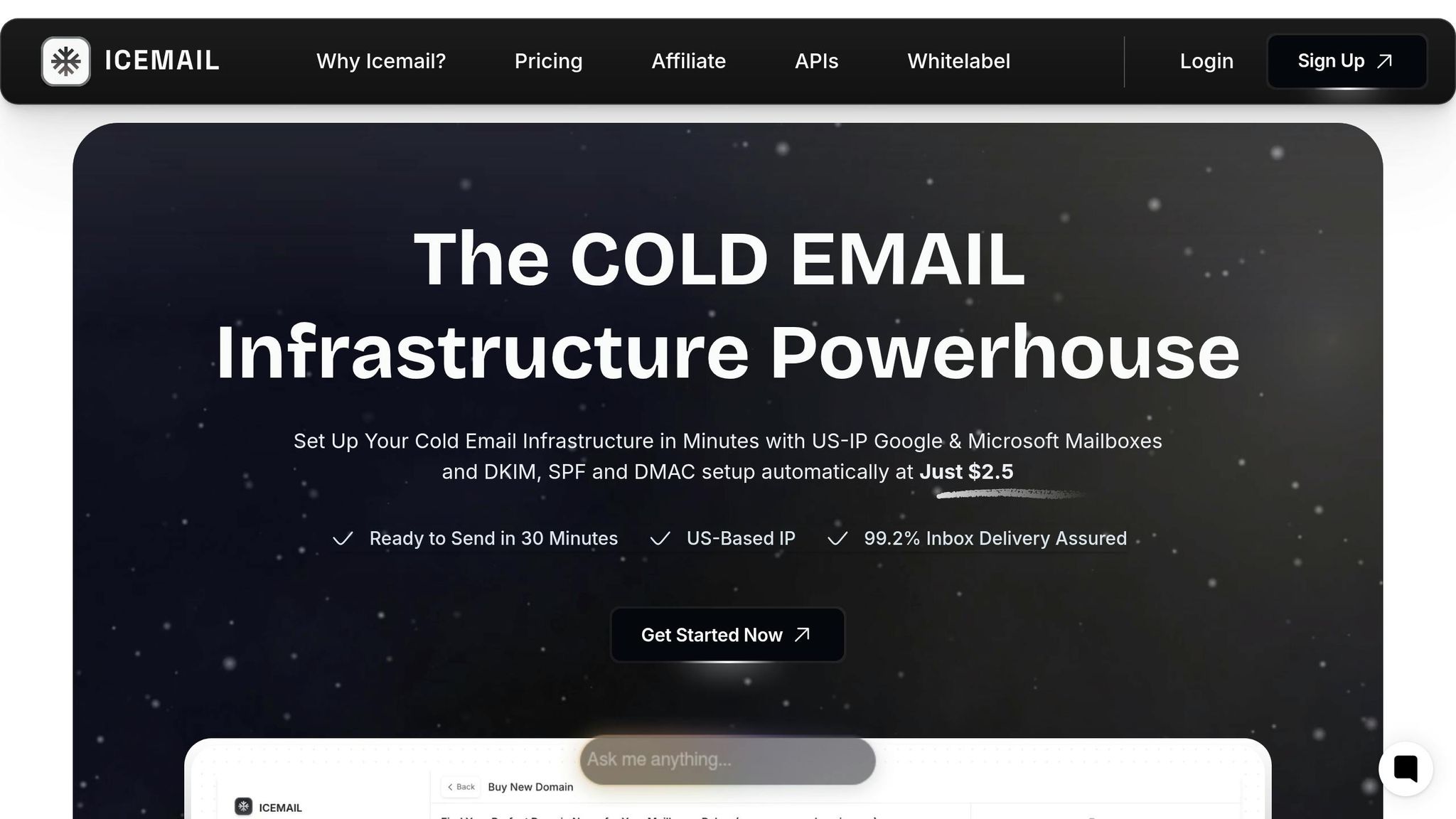
For U.S.-based teams, Icemail.ai offers a fast, compliant cold email infrastructure. It allows users to purchase Google Workspace and Microsoft mailboxes starting at $2.5 per mailbox/month, with an onboarding process that takes just 10 minutes - much quicker than manual setups.
Icemail.ai simplifies GDPR compliance by automating the setup of DKIM, DMARC, and SPF protocols. It also supports bulk mailbox purchases, instant domain setup, and 1-click import/export, making it invaluable for managing multiple sending domains. With sending limits of around 30 emails per day per inbox, the platform helps mitigate deliverability risks.
Compared to competitors like Zapmail.ai, Icemail.ai stands out for its quicker setup times, streamlined DNS management, and smoother onboarding process, making it a top choice for reliable and efficient email infrastructure.
Security Measures and Data Subject Rights
On the security side, role-based access controls are essential. Only team members who need access to raw prospect data should have it, with permissions enforced across your CRM and outreach platforms.
GDPR also emphasizes data subject rights. For example, under Article 15, you must fulfill Subject Access Requests within 30 days. Similarly, Article 17 requires you to delete a contact's data upon request, including from CRMs, outreach tools, enrichment databases, and suppression lists. Automating these workflows is crucial, as manual processes across multiple systems can lead to delays and errors. Setting up a 30-day deletion process ensures you're ready to handle such requests efficiently.
Conclusion and Key Takeaways
GDPR compliance isn't just about following rules - it can actually give your outreach efforts an edge. Cold emailing in the EU is legal as long as you have a clear legal basis, respect opt-out requests, and collect only the data you truly need.
To stay on the right side of GDPR, here’s what you should focus on:
- Document a Legitimate Interest Assessment for every campaign.
- Regularly audit your data sources.
- Maintain a centralized suppression list that syncs across all tools.
And don’t forget - B2B contact data goes stale quickly, so keeping your lists clean and up-to-date is a must.
"Compliance is not a barrier to sales - it is a trust signal." - Vonsel
Beyond the basics, technical tools can make compliance easier and more effective. Features like automated SPF, DKIM, and DMARC setups, real-time bounce detection, and one-click unsubscribe options are essential for meeting GDPR standards. Platforms such as Icemail.ai simplify this process with automated setups, quick onboarding, and premium mailbox options starting at just $2. Compared to competitors like zapmail.ai, these tools not only improve deliverability but also future-proof your outreach against evolving regulations.
Looking ahead, it’s worth preparing for the EU AI Act, which comes into effect in August 2026. This new regulation will require teams using AI to generate or send outreach emails to disclose that fact in every message. Start building this transparency into your email templates now to avoid last-minute adjustments.
Ultimately, GDPR compliance is more than just a legal requirement - it’s a strategy for better deliverability and stronger sender reputation. By focusing on clear documentation, easy opt-out processes, and strong technical infrastructure, you’ll not only meet regulations but also enhance the effectiveness of your outreach. Lower spam rates and improved inbox placement are just the beginning.
Related reading
Frequently asked questions
What types of contact information count as personal data under GDPR?+
Work emails that identify individuals (like j.smith@company.com) and direct phone numbers are considered personal data under GDPR. However, generic company emails (info@company.com) or main office phone lines don't qualify as personal data since they don't identify specific individuals.
Can I use legitimate interest for all B2B cold emails in the EU?+
Legitimate interest works for most B2B corporate employees, but not all contacts. You must complete a documented Legitimate Interest Assessment for each campaign type. Certain contacts like sole traders and partnerships require explicit consent instead, and Germany has stricter rules requiring prior consent even for B2B outreach.
How long can I keep prospect data under GDPR retention rules?+
Best practice is to retain B2B prospect data for 24 months from the last meaningful engagement (reply, click, or meeting). If there's no activity for 36 months, flag or remove the record. You can reset the retention period by re-verifying contacts through public sources like LinkedIn or company websites.
What information must I include in cold emails to EU prospects?+
Every EU outreach email must include your identity, a valid physical postal address, the legal basis for processing (like Legitimate Interest), and a link to your privacy policy. In your first email, disclose where you found their contact information to meet GDPR transparency requirements.
What are the penalties for GDPR non-compliance in cold emailing?+
GDPR violations can result in fines up to €20 million or 4% of global annual revenue, whichever is higher. Beyond financial penalties, non-compliance can damage your email deliverability, sender reputation, and result in blocks from major inbox providers like Gmail and Yahoo.
Should I delete contacts from my database when they opt out?+
Don't fully delete opt-out records. Instead, maintain a permanent suppression list with minimal data (email address and opt-out date) to prevent accidentally re-contacting them. This suppression list is essential for demonstrating GDPR compliance and doesn't violate storage limitation rules since its purpose differs from marketing.
How does GDPR differ from US email compliance laws like CAN-SPAM?+
GDPR requires a documented lawful basis before sending emails and emphasizes transparency, while CAN-SPAM operates on an opt-out model allowing emails without prior consent. GDPR mandates clear data sourcing disclosure and stricter consent requirements, whereas CAN-SPAM focuses on honest subject lines, physical addresses, and 10-day opt-out processing.