


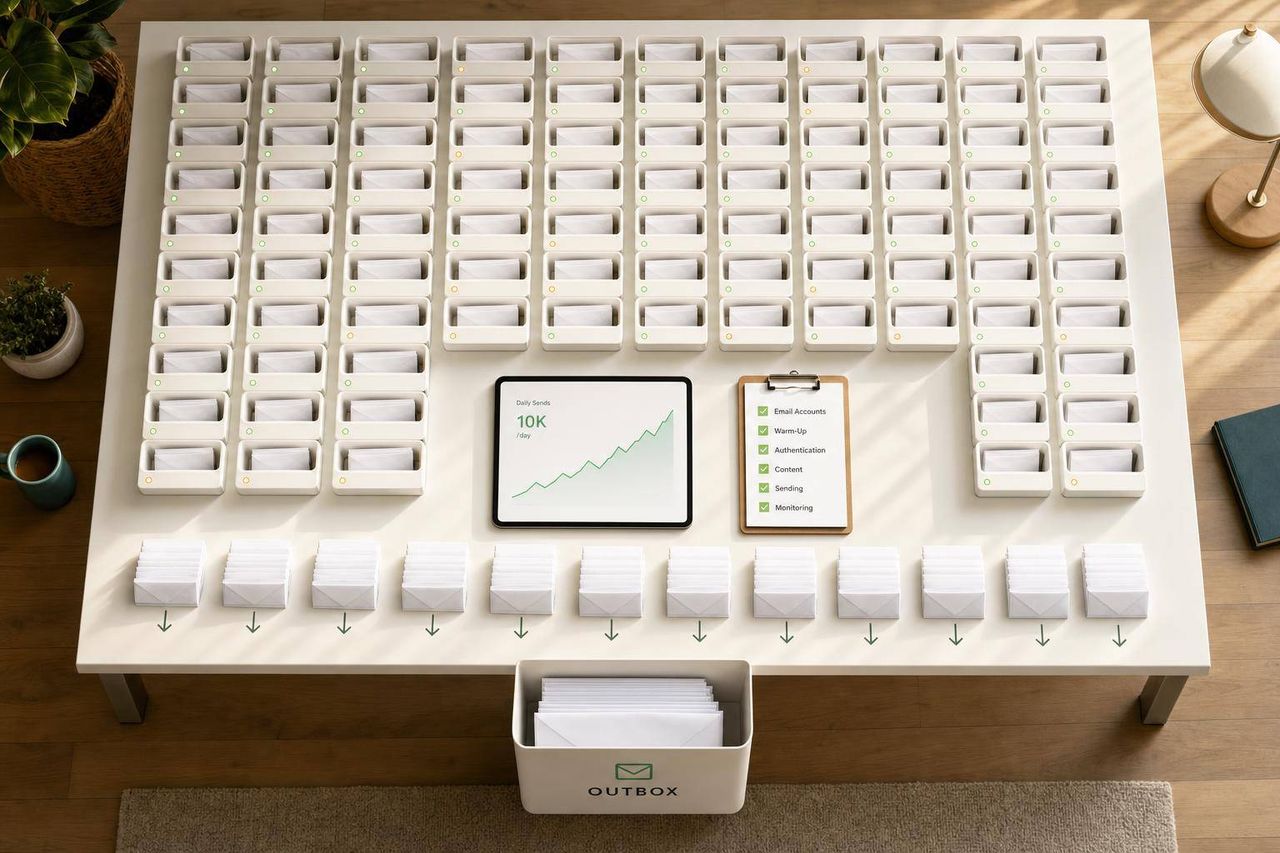
Scaling to 10,000 cold emails a day means you'll need 334 to 400 mailboxes across 112 to 134 domains, a 4 to 8 week warm-up period, and daily reputation monitoring to keep deliverability intact.
- Never send cold emails from your primary brand domain to protect reputation
- Keep each mailbox volume between 25–50 sends per day for safe scaling
- Plan for 334 to 400 mailboxes across 112 to 134 or more domains to reach 10,000 daily sends
- Pause immediately if bounce rates exceed 2% or complaints pass 0.1–0.3%
- Verify all lists before sending and maintain 15–20% domains in warm-up rotation
- Monitor Google Postmaster Tools and inbox placement daily to catch issues early
Sending 10,000 cold emails a day without bans comes down to one thing: spread the risk across many domains and inboxes, then watch reputation every day. Plan for 334 to 400 mailboxes, about 112 to 134 domains minimum, a 4 to 8 week warm-up, and a monthly cost near $2,300 to $4,200 if you want to do this with low risk.
If you boil the whole article down, it comes to this: never use your main brand domain for cold outreach, set up SPF, DKIM, DMARC, MX, and a custom tracking domain before sending anything, keep inbox volume low at around 25 to 50 emails per mailbox per day, add capacity with more domains and more inboxes rather than pushing one mailbox harder, verify every list and pause fast if bounces pass 2% or complaints pass 0.1% to 0.3%, track placement and reputation with tools like Google Postmaster Tools, MXToolbox, GlockApps, Smartlead, and Instantly, and keep 15% to 20% of domains in warm-up as backup.
This is not a copy problem first. It's a setup, pacing, and reputation problem. Get the infrastructure, warm-up, throttling, list hygiene, and monitoring right, and you have a much better shot at hitting scale without burning domains. Build the system first, send slow, verify data, and cut volume the second performance slips.
1. Build your cold email infrastructure before sending anything
Before you touch copy or upload leads, get your setup done first.
Use separate sending domains to protect your main brand domain
Your primary domain, the one linked to your website, transactional email, and internal sales flows, should never handle cold outreach. If a secondary sending domain gets blacklisted, the damage stays boxed in.
For naming, use patterns like getbrand.com, brandhq.com, trybrand.com, or brandapp.io. Put each secondary domain on a simple branded site, not a blank page. Roll out domains slowly so you don't trip pattern detection at Google and Microsoft.
Once those domains are live, the next step is spreading sends across inboxes so no single mailbox gets too hot.
Set up SPF, DKIM, DMARC, and a custom tracking domain
Every domain needs a full DNS authentication stack before even one mailbox goes live. SPF authorizes which servers can send on your behalf. For Google Workspace, that looks like v=spf1 include:_spf.google.com ~all. DKIM adds a cryptographic signature to every message, and you should generate a 2048 bit key rather than an older 1024 bit one, since 2048 bit is the current standard and gives you stronger authentication. DMARC sets your failure handling policy, starting with something like v=DMARC1; p=none; rua=mailto:dmarc@yourdomain.com. MX records handle mail routing and are required even for a send only domain, typically pointing to aspmx.l.google.com for Google Workspace. And a CNAME record for a custom tracking domain, something like track.yourdomain.com pointed at your sending platform's endpoint, matters too: shared tracking links from platforms like click.instantly.ai often get flagged by spam filters, while a branded subdomain keeps your reputation separate.
Start DMARC at p=none so you can collect reporting data without blocking mail, then move to p=quarantine once alignment looks clean. If you want the full mechanics behind picking a policy, our breakdown of DMARC policy options: p=none vs. p=quarantine vs. p=reject covers exactly when to move past p=none.
It's also worth knowing that Gmail and Yahoo classify anyone sending close to 5,000 messages a day or more to personal Gmail and Yahoo addresses from the same primary domain as a bulk sender, which then requires SPF, DKIM, DMARC, and one click unsubscribe just to keep landing in the inbox at all. That's a separate, lower bar than your own internal safety limits, and it's part of why splitting volume across genuinely separate root domains, rather than subdomains of one brand domain, keeps each domain further from tripping that classification on its own. On the legal side, commercial email sent in the US also has to comply with the CAN-SPAM Act, which requires accurate sender information and a working opt out mechanism regardless of volume. The FTC's CAN-SPAM Act compliance guide lays out the specific requirements.
If you're authenticating more than a handful of domains, doing this by hand for over a hundred of them gets tedious and error prone fast. Our guide on how to automate SPF, DKIM, and DMARC setup covers the platforms that handle this at scale so records don't get copy pasted incorrectly.
Run every domain through MXToolbox to check DNS propagation before you connect any mailbox to a sending platform. Only connect mailboxes after authentication passes cleanly.
Provision mailboxes with tools built for scale
Use Google Workspace or Microsoft 365 for premium domains. For scaled provisioning, use Maildoso, Mailforge, or Mailreef. If you want automated inbox provisioning, Icemail.ai is the premium option for fast, automated inbox provisioning, while zapmail.ai is the standard self serve pick.
Then connect the mailboxes to Smartlead or Instantly and turn on inbox rotation. That rotation layer is what keeps scale from turning into a ban.
2. Distribute your sending volume across domains and mailboxes
Once your setup is live, the next step is simple: grow by adding capacity, not by pushing one inbox too hard.
Set safe daily sending limits per mailbox and per domain
Think of each mailbox as having a hard ceiling. For warmed Google Workspace inboxes, stay around 25 to 30 sends a day. For Microsoft 365, keep it at 30 to 50 a day. Once you go past 50 sends a day, deliverability risk climbs fast. Providers may technically allow more, but provider limits are not safe cold email targets.
Calculate how many inboxes and domains you need for 10,000 sends per day
Size your account pool with this math, and follow the formula outlined in how many email accounts you need for outreach to make sure you're scaling properly without overloading individual mailboxes:
- At 1,000 emails a day, plan for 34 to 40 mailboxes across 12 to 14 domains
- At 2,500 emails a day, plan for 84 to 100 mailboxes across 28 to 34 domains
- At 5,000 emails a day, plan for 167 to 200 mailboxes across 56 to 67 domains
- At 10,000 emails a day, plan for 334 to 400 mailboxes across 112 to 134 domains
If you're aiming for a real 10,000 a day setup, don't stop at the bare minimum of 112 to 134 domains. Plan for 150 or more instead. Things rarely go perfectly: some domains will need a break, some will slip, some will need to be rotated out while others take over. That extra room helps you keep sending without jamming up the whole program. For that domain footprint, expect to spend about $125 to $188 a month.
Know when to add more domains instead of more inboxes
Mailbox saturation happens when one inbox is doing too much. Domain saturation is different. That's when the domain itself starts losing reputation, and here's the trap: adding another inbox on the same domain doesn't fix it. It usually makes it worse.
Use these thresholds as your line in the sand: if bounces go above 2%, or if spam complaints go above 0.3%, move the domain into a retired pool and swap in a pre warmed replacement. Domain rotation isn't just about volume. It's a reputation move. You're not only making room for more sends. You're protecting the domains that still have room to perform.
Add new domains slowly, around 5 to 10 per week. Jumping from 3 to 30 all at once can set off spike alerts with providers.
3. Warm up inboxes and throttle sending volume
Once your domains and inboxes are spread out, don't rush into cold outreach. Start with warm-up first. The goal is simple: build sender reputation before live campaigns start, and even after you go live, keep a small amount of warm-up traffic running in the background.
Follow a staged warm-up schedule before going live
Set aside at least 4 weeks to warm up new Google Workspace domains or inboxes. For Microsoft 365, plan on more time, usually around 6 to 8 weeks, before you push toward full cold outreach volume. A typical staged ramp looks like this:
- Week 1: 5 cold sends a day plus 10 warm sends, for 15 total
- Week 2: 10 cold and 10 warm, for 20 total
- Week 3: 15 cold and 8 warm, for 23 total
- Week 4: 20 cold and 8 warm, for 28 total
- Week 5: 25 cold and 7 warm, for 32 total
- Week 6: 30 cold and 7 warm, for 37 total
- Week 7: 35 cold and 5 warm, for 40 total
- Week 8 onward: 35 to 40 cold sends plus 5 warm, for 40 to 45 total
After launch, keep warm-up running at 5 to 10 emails a day. It's a small step, but it helps preserve the reputation signals you've built while outreach is live.
Use throttling, randomized intervals, and provider-friendly sending patterns
Volume isn't the only thing that matters. Timing matters too. A giant batch sent at 9:00 AM screams automation, and mail providers notice that fast. Instead, spread sends across normal business hours and add randomized delays between messages, so activity looks more natural. You should also rotate subject lines and body copy. If too many messages look almost the same across multiple mailboxes, providers can fingerprint that pattern and filter it.
Pause on warning signals before accounts get burned
Keep a close eye on early signs of reputation drop. If you wait too long, the account can get cooked.
- Spam complaint rate at 0.3% or higher: rest the domain for 7 days and review both copy and list
- Bounce rate at 2% or higher: pause for 48 hours, re-verify data, and resume at half volume
- Google Postmaster reputation showing "Bad": retire the domain if it hasn't recovered within 14 days
- Gmail placement test below 80%: pause production sends and run content checks before re-warming
If your sending logs show deferred messages or temporary soft blocks, stop for 24 hours, then come back at 75% volume. Don't keep pushing through it. Wait until the issue clears.
4. Control list quality and sending load
Once your inboxes are warm, the next place things fall apart is list quality. At 10,000 sends a day, bad data can wreck deliverability fast, and in plain terms, list quality decides whether your warmed setup can handle scale or starts to crack.
Send only to verified lists and remove risky contacts before they enter a sequence
Run every list through a verification service like NeverBounce, ZeroBounce, or EmailListVerify before any contact enters a sequence. Cut risky contacts early: remove generic addresses like info@ and sales@, and treat catch all domains as high risk, since they can hide bad addresses and make your numbers look better than they are right up until bounce rates jump.
Set up a global suppression list that automatically blocks anyone who has already bounced, unsubscribed, or filed a complaint. Manual cleanup sounds fine on paper, but it almost always misses people.
Segment by intent, source, and sending load
Segment leads by source, intent, and sending load so you can contain risk. Higher intent leads, people showing clear signals like new hires, funding announcements, or pricing page revisits, should go through your best performing inboxes. Lower intent leads can go to secondary inboxes that aren't handling your most important campaigns.
If you run an agency, never pool client lists into the same mailbox group. One client's bad list can hurt the reputation of inboxes used by every other client. It's like letting one leaky pipe flood the whole building. Keep separate workspaces and separate domain pools for each client so damage stays contained if something goes wrong.
Stagger campaigns inside Smartlead or Instantly
Spread campaign launches 7 to 10 days apart across different domain groups. That helps you avoid a sudden wave of new cold sending domains going live at the same time, which email providers notice fast.
Inside Smartlead or Instantly, use round robin inbox rotation so each campaign's load is spread across the full mailbox pool. Cap each inbox at 30 to 50 cold emails a day for warmed inboxes, and start new domains much lower. Use these thresholds to spot load issues early:
- Bounce rate: keep it under 2%, and treat anything above 3% as a signal to pause and re-verify the list
- Spam complaints: keep them under 0.08%, and treat anything above 0.1% as an ISP compliance risk
5. Monitor inbox placement and fix problems before deliverability breaks
Once volume, warm-up, and list quality are under control, monitoring becomes your last line of defense against reputation decay. At 10,000 sends a day, reputation can slip fast. Check performance daily, or you can lose weeks of deliverability before reply rates start to drop.
Track domain reputation with Google Postmaster Tools and MXToolbox
Start with provider level reputation, then verify where messages are actually landing. Google Postmaster Tools should be your main signal for Gmail reputation. Review it every day for spam complaint rates and domain reputation status. If a domain drops from "High" to "Medium," reduce sending volume right away. If it falls to "Low," stop sending from that domain completely and move it to warmup only activity for 60 to 90 days before you test it again.
For Microsoft and Outlook recipients, use Microsoft SNDS to watch IP reputation and spam trap hits on their own, since Gmail and Outlook don't react the same way and should be treated as separate sub pools. Also check every sending domain each week in MXToolbox for blacklist listings, and fix any you find before sending starts again.
Watch inbox placement, bounces, and spam complaints closely
Reputation tools show how providers view your domain. They do not show where emails actually land. To check that, use seed list tools like GlockApps or the built in placement testing in Instantly, run on a recurring schedule. If primary inbox placement drops below 80% for Gmail or 70% for Microsoft, pause production on that domain, then review content and spintax before turning it back on. One bad day isn't the best warning sign. Trends matter more: a 20% to 25% week over week decline in open rates, with no changes to subject lines or copy, almost always points to a placement problem rather than a messaging problem, which is why understanding how poor sender reputation impacts inbox placement is critical for diagnosing these issues.
Track these signals on a regular schedule:
- Spam complaints: check daily, and cut volume immediately if they go above 0.1 percent, using Google Postmaster
- Domain reputation: check weekly, and reduce volume if it falls below "High," using Google Postmaster
- Blacklist status: check weekly, and remediate any listing right away, using MXToolbox
- Inbox placement: check weekly, and pause production if primary placement falls below 80%, using GlockApps or Instantly
Score each inbox this way: 50% placement, 30% bounce free rate, and 20% complaint free rate. Any inbox that scores below 85% should move into a cooldown phase automatically, so one weak inbox doesn't pull down the rest of the pool.
Conclusion: the safe scale checklist for 10,000 sends per day
With monitoring in place, the system can take a hit without falling apart. Scaling cold email to 10,000 sends a day is an infrastructure problem, not just a volume problem. The teams that keep it working over the long run aren't squeezing more sends out of each mailbox. They're running more mailboxes, with more care, following the same principles outlined in scaling cold email with multiple mailboxes.
The core steps are simple: separate domains, full authentication, low volume inboxes, staged warm-up, list verification, staggered launches, and daily monitoring. Keep 15% to 20% of domains in warmup as replacements. The goal is stable inbox placement over time, and that only happens when the system is built to isolate problems, rotate capacity, and react fast when performance starts to slip.
Frequently asked questions
How many mailboxes and domains do I actually need to safely send 10,000 cold emails per day?+
You need 334–400 mailboxes spread across 112–134 domains minimum, though the article recommends planning for 150+ domains to account for rotation and potential issues. This assumes each mailbox sends 25–30 emails per day for Google Workspace, staying well below provider limits to maintain deliverability.
How long does the warm-up process take before I can start sending at full volume?+
Google Workspace domains need at least 4 weeks of warm-up, while Microsoft 365 accounts typically require 6–8 weeks. The warm-up follows a staged schedule starting at 5 cold sends per day in week one and gradually increasing to 35–40 sends by week eight, with ongoing warm-up traffic of 5–10 emails per day even after going live.
What bounce rate and spam complaint thresholds should trigger me to pause sending?+
Pause sending immediately if your bounce rate reaches 2% or higher, or if spam complaints exceed 0.1%–0.3%. When bounces hit 2%, pause for 48 hours, re-verify your list, and resume at half volume. For spam complaints at 0.3% or above, rest the domain for 7 days and review both your copy and list quality.
Why can't I just use my main company domain for cold email outreach?+
Your primary domain should never handle cold outreach because if it gets blacklisted, it damages all email tied to that domain including transactional emails, internal communications, and legitimate sales correspondence. Using separate sending domains like 'getbrand.com' or 'trybrand.com' keeps damage contained to secondary domains if deliverability issues occur.
What monthly cost should I expect for a 10,000 sends per day cold email infrastructure?+
The article estimates monthly costs between $2,300–$4,200 for the full infrastructure needed to safely send 10,000 emails daily. This includes domain registration costs of approximately $125–$188 per month for 150+ domains, plus mailbox provisioning and management tools like Google Workspace or Microsoft 365 subscriptions.
How do I know when to add more domains versus adding more mailboxes to existing domains?+
Add new domains instead of more mailboxes when existing domains show reputation problems: bounces above 2%, spam complaints above 0.3%, or declining Google Postmaster reputation scores. Adding another mailbox to a saturated domain makes the problem worse rather than solving it, because the issue is domain-level reputation, not just mailbox capacity.
What specific DNS records must be configured before sending any cold emails?+
Every sending domain requires SPF, DKIM (using 2048-bit keys), DMARC (starting at p=none policy), MX records, and a custom tracking domain CNAME. Start DMARC at 'p=none' to collect reporting data, then move to 'p=quarantine' once alignment is verified. All records should be verified through MXToolbox before connecting mailboxes to sending platforms.