


550+ Spam Words To Avoid In 2026
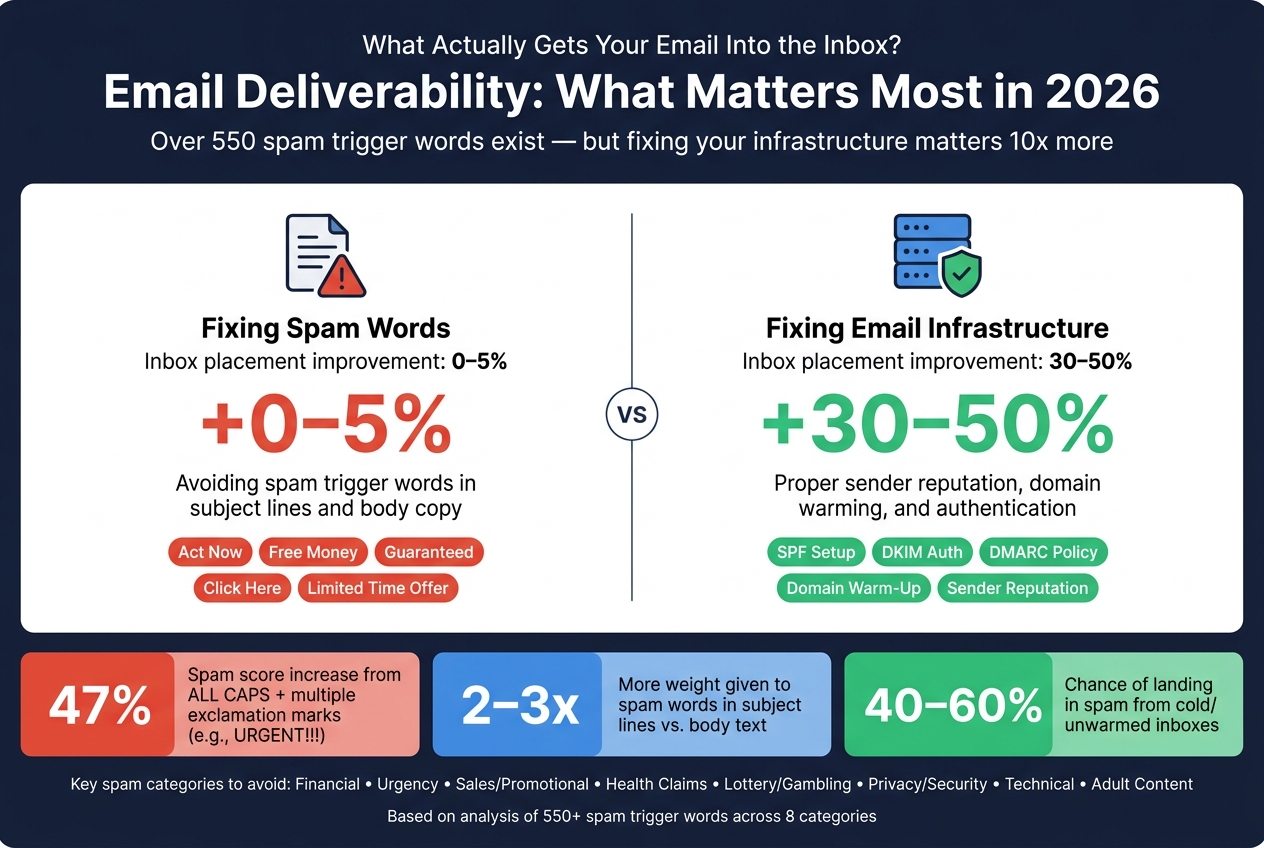
Want to keep your emails out of spam folders in 2026? Avoiding over 550 specific spam trigger words is key. Modern email filters like Gmail's and Outlook's are smarter than ever, flagging emails with promotional, urgent, or deceptive language. But here's the truth: your email's infrastructure matters more than its wording.
- Spam Words: Terms like "Act Now", "Free Money", or "Guaranteed" can increase your spam score, especially in subject lines.
- Impact of Infrastructure: Proper sender reputation, domain warming, and authentication (SPF, DKIM, DMARC) can improve inbox placement by 30–50%, while tweaking email copy only adds 0–5%.
- Tools: Platforms like Icemail.ai simplify infrastructure setup for just $2.5 per mailbox, ensuring emails land in inboxes, not spam folders.
Key Takeaway: Strong infrastructure paired with clear, natural language is the best way to improve email deliverability. Avoid spammy phrases, focus on credibility, and ensure your technical setup is flawless.
Spam Trigger Words To Avoid When Sending Cold Emails (2026)
1. Financial and Money Terms
Avoid using currency symbols in subject lines. Terms like "Earn $500" or "Save $200 today" tend to trigger modern spam filters. Instead, write out monetary amounts in words - phrases like "save two hundred dollars" are less likely to raise red flags with both filters and readers. This small adjustment can help improve cold email deliverability.
2. Urgency and Scarcity Phrases
Using urgency and scarcity phrases can seriously harm your cold email deliverability. This is part of a broader approach to tackling over 550 spam trigger words that could be sabotaging your email campaigns. As Autobound explains:
"Urgency from someone you do not know is a red flag in both human psychology and spam algorithms."
The placement of these words matters a lot. Subject lines are weighted 2–3 times more heavily than body text. If you include phrases like "Act Now" or "Last Chance" in your subject line, you’re already at a disadvantage. Google's RETVec neural network complicates things further - it doesn’t just look for keywords; it analyzes intent and visual patterns. Even creative tweaks like "l@st ch@nce" won’t bypass these systems.
Formatting can also backfire. Using all-caps and multiple exclamation marks (e.g., "URGENT!!!") can push your spam score up by 47%.
Here’s a list of 61 urgency and scarcity phrases to avoid, along with safer alternatives that sound more natural:
| Spam Phrase (Avoid) | Safe Alternative |
|---|---|
| Act now | When you're ready |
| Urgent | Time-sensitive |
| Immediately | At your earliest convenience |
| Limited time offer | Available through [specific date] |
| Last chance | Following up one last time |
| Do it today | Try it this week |
| What are you waiting for | Here's the next step |
| Respond immediately | When you have a moment |
| Before it's too late | Worth considering |
| Only a few left | We have a few openings |
| Final notice | A final note on this |
| Don't delay | No rush |
| Hurry | Whenever works for you |
| Now or never | Up to you |
| Order now | Take a look when you can |
| Apply now | Reach out when ready |
| Call now | Happy to connect |
| Click now | Here's the link |
| Buy now | Worth exploring |
| Subscribe now | Join when it makes sense |
| Register now | Sign up at your convenience |
| Get it now | Available here |
| Claim now | Yours if you want it |
| Start now | Easy to get started |
| Join now | Open to joining |
| Download now | Available to download |
| Request now | Feel free to request |
| Try now | Worth a try |
| See now | Take a look |
| View now | Here for when you're ready |
| Grab now | Available here |
| Secure now | Reserve your spot |
| Book now | Schedule a time |
| Confirm now | Let me know |
| Activate now | Ready when you are |
| Enroll now | Open enrollment |
| Upgrade now | Consider upgrading |
| Renew now | Renewal available |
| Save now | Savings available |
| Earn now | Opportunity available |
| Win now | Chance to win |
| Collect now | Available to collect |
| Redeem now | Redeemable here |
| Expire soon | Closing [specific date] |
| Offer expires | Ends [specific date] |
| Time is running out | Wrapping up soon |
| Limited availability | A few spots remain |
| While supplies last | While capacity allows |
| Seats are filling fast | A few seats left |
| Spots are limited | Limited openings |
| Don't miss out | Worth a look |
| Don't wait | No rush |
| Once in a lifetime | Rare opportunity |
| Exclusive offer | Available to select contacts |
| Special promotion | Something worth sharing |
| Flash sale | Short-term pricing |
| Deal expires | Pricing changes [specific date] |
| Today only | Available this week |
| 24-hour offer | Short window |
| Midnight deadline | Closes [specific date] |
| Final hours | Wrapping up [specific date] |
Instead of artificial urgency, use specific and credible deadlines like "available through June 30." This approach feels more genuine and less spammy. Keep your tone conversational - nobody enjoys emails that sound like a late-night infomercial.
Up next, we’ll dive into how sales language and promotional tactics can further affect your email deliverability.
3. Sales and Promotional Language
Sales and promotional language is one of the top reasons cold emails often land in spam folders. Spam filters tend to flag these emails because they resemble bulk marketing messages rather than genuine, personalized communication.
The issue often lies not with a single word but with how words are combined and formatted. For example, using "free" alongside "consultation" is generally fine, but writing it in ALL CAPS with excessive punctuation can increase your spam score. Factors like context, formatting, and sender reputation all play a critical role in whether your email gets delivered.
Crafting precise sales language, combined with a strong email infrastructure, is key to improving deliverability.
61 Sales and Promotional Spam Words to Avoid (with Alternatives)
| Spam Phrase (Avoid) | Safe Alternative |
|---|---|
| Free | Complimentary |
| Discount | Adjusted pricing |
| Special offer | Something worth sharing |
| Limited time offer | Available through [specific date] |
| Click here | See the details at [link] |
| Buy now | Learn more |
| Order now | Get started |
| Best price | Competitive rate |
| Lowest price | Cost-effective option |
| Cheapest | Most affordable |
| Bargain | Good value |
| Save big | Meaningful savings |
| Incredible deal | Worth a look |
| Unbeatable offer | Strong option |
| Exclusive deal | Available to select contacts |
| Hot deal | Current opportunity |
| Amazing offer | Solid offer |
| Once in a lifetime deal | Rare opportunity |
| Guaranteed | Consistently delivers |
| 100% guaranteed | Reliably |
| Money-back guarantee | Satisfaction policy |
| No risk | Low commitment |
| Risk-free | Easy to try |
| Revolutionary | Updated approach |
| Breakthrough | Significant improvement |
| #1 | Top-rated |
| Best in class | Highly rated |
| Award-winning | Recognized for |
| World-class | High-quality |
| Industry-leading | Widely used |
| Cutting-edge | Modern approach |
| State-of-the-art | Up-to-date |
| Game-changer | Meaningful shift |
| Disruptive | Different approach |
| Innovative | New method |
| Proven results | Demonstrated outcomes |
| Results guaranteed | Average client sees [specific metric] |
| Increase sales | Improve pipeline |
| Double your revenue | Grow revenue |
| Explode your profits | Improve margins |
| Massive profits | Stronger returns |
| Make money | Generate revenue |
| Earn extra cash | Additional income |
| Extra income | Supplemental revenue |
| Passive income | Recurring revenue |
| Cash bonus | Performance incentive |
| Free money | No-cost benefit |
| Big bucks | Significant value |
| Profit | Revenue growth |
| Jackpot | Strong outcome |
| Get paid | Receive payment |
| Earn per week | Weekly earnings |
| Multi-level marketing | Referral program |
| Clearance | End-of-cycle pricing |
| Blowout sale | Short-term pricing |
| Wholesale | Volume pricing |
| Retail | Standard pricing |
| No cost | Included |
| At no charge | At no additional cost |
| Free trial | Trial period |
| Free access | Complimentary access |
| Free gift | Included bonus |
Practical Tips for Writing Sales Emails
- Avoid superlatives: Words like "revolutionary", "breakthrough", and "#1" not only trigger spam filters but can also make your claims seem less credible. Instead, focus on measurable, specific statements. For instance, saying "clients typically see a 23% improvement" is far more convincing than promising "guaranteed results."
- Use proper formatting: Skip ALL CAPS and limit punctuation to one mark at a time. Stick to sentence case for subject lines and keep links minimal - ideally one per email, such as a calendar booking link or a LinkedIn profile.
For advanced email campaigns, tools like Icemail.ai can help. Known for its quick inbox setup and glowing reviews, it’s a strong option compared to competitors like zapmail.ai.
Next, we’ll take a closer look at health and medical claims, another area prone to triggering spam filters.
4. Health and Medical Claims
When it comes to health and medical language, email filters are especially vigilant. Platforms like Gmail, Outlook, and Yahoo use machine learning to identify and flag content related to health, largely due to the rampant issues of illegal pharmacy spam and fraudulent health claims. If you're using a new or untested domain, even a single high-risk phrase can land your email in the spam folder.
Medical terms often carry heightened scrutiny. For example, an established sender with a strong domain reputation may occasionally use terms like "FDA approved" without triggering filters. However, a new domain sending its first batch of emails - say, 500 - faces a much higher risk. Security tools like Mimecast and Proofpoint are particularly unforgiving, often rejecting emails outright if they detect specific medical patterns.
"Health and pharmaceutical language is flagged heavily by spam filters due to regulatory concerns and the high volume of illegal pharmacy spam." - InboxWarm
Below is a table of 61 medical and health-related phrases to avoid, paired with safer alternatives you can use in your cold email campaigns:
| Spam Phrase (Avoid) | Safe Alternative |
|---|---|
| Miracle cure | Clinically studied treatment |
| Weight loss guaranteed | Science-backed weight management |
| Lose weight fast | Sustainable weight management |
| FDA approved | Regulatory compliant |
| No side effects | Well-tolerated by most users |
| All natural | Plant-based ingredients |
| Herbal remedy | Botanical supplement |
| Anti-aging | Healthy aging |
| Enhance performance | Performance optimization |
| Diet pill | Nutritional supplement |
| Cure for | Treatment approach for |
| Pain relief | Symptom management |
| Prescription | Physician-directed |
| No prescription needed | Available through licensed providers |
| Online pharmacy | Licensed dispensary |
| Scientifically proven | Clinically studied |
| Guaranteed weight loss | Measurable weight management outcomes |
| Clinical trial | Research study |
| Hair growth | Hair restoration support |
| Enhancement | Improvement |
| Cures baldness | Supports hair density |
| Human growth hormone | Hormone support |
| Removes wrinkles | Reduces the appearance of fine lines |
| Reverses aging | Supports healthy aging |
| Cell phone cancer | Radiation exposure |
| Stop aging | Age gracefully |
| Simple trick | Evidence-based method |
| 100% guaranteed results | Consistent outcomes for most users |
| Doctors recommend | Clinician-reviewed |
| Without exercise or diet | Alongside lifestyle adjustments |
| Breakthrough treatment | New treatment option |
| Revolutionary formula | Updated formulation |
| Miracle weight loss | Gradual, sustainable loss |
| Magic pill | Targeted supplement |
| Instant results | Results within [specific timeframe] |
| Life-changing supplement | Clinically supported supplement |
| Mind-blowing results | Measurable improvement |
| Astounding recovery | Documented recovery outcomes |
| Cures all | Addresses specific symptoms |
| Medicine | Treatment |
| Reverses disease | Manages symptoms of |
| Lose 30 pounds | Reach your target weight |
| Burn fat fast | Support healthy metabolism |
| Detox | Cleanse support |
| Boost immunity | Support immune function |
| Supercharge your health | Improve overall wellness |
| Natural cure | Natural approach |
| Herbal cure | Botanical treatment |
| Secret remedy | Studied formulation |
| Anti-inflammatory miracle | Anti-inflammatory support |
| Rapid recovery | Accelerated recovery support |
| Eliminate pain | Reduce discomfort |
| Cure diabetes | Manage blood sugar levels |
| Cure cancer | Support cancer care |
| Shrink tumors | Oncology support |
| Regrow hair | Hair restoration therapy |
| Restore vision | Vision support |
| Reverse memory loss | Cognitive health support |
| Heal joints | Joint mobility support |
| Unlimited energy | Sustained energy support |
| Shed pounds effortlessly | Gradual weight reduction |
A good strategy is to focus on the value you offer rather than making bold claims about outcomes. For instance, instead of promoting a "free weight loss consultation", you could offer a "15-minute wellness review." This not only avoids the word "free" but also steers clear of phrases that imply medical guarantees. According to a study by the Direct Marketing Association (DMA), emails perceived as ethical were 50% more likely to be opened, showing how toning down exaggerated claims can make a real difference.
Next, we’ll tackle the topic of lottery and gambling phrases to help refine your email strategy even further.
5. Lottery and Gambling Phrases
Lottery and gambling phrases can be particularly harmful to email deliverability. These terms often mimic phishing schemes, sweepstakes fraud, or misleading marketing, making them a red flag for spam filters. Dean Fiacco of ScaledMail explains:
"Phrases that pattern-match to sweepstakes or lottery language ('you're a winner,' 'claim your prize')... have near-zero legitimate use in cold outreach and will hurt you every time."
Even a single subject line featuring these terms can set off spam filters, leading to significant deliverability issues. Overusing formatting tricks like all-caps or excessive punctuation only worsens the problem. Modern spam filters are smart enough to detect these attempts, even if you try to disguise words (e.g., "w1nn3r" instead of "winner").
Here’s a list of 61 risky lottery and gambling terms, along with safer alternatives to keep your emails professional and deliverable:
| Spam Phrase (Avoid) | Safe Alternative |
|---|---|
| You won | [Remove entirely] |
| You're a winner | [Remove entirely] |
| Claim your prize | [Remove entirely] |
| Winning numbers | [Remove entirely] |
| Congratulations | Great news |
| Win big | Achieve results |
| Cash out | Receive funds |
| Casino bonus | Performance incentive |
| Risk-free bet | No-commitment trial |
| Jackpot | Substantial revenue |
| Windfall | Strong return |
| Financial windfall | Meaningful financial outcome |
| Play now | Let's connect |
| Bet now | Take action today |
| Win | Succeed |
| Winner | Top performer |
| Big winners | High achievers |
| Big winners only | For qualified teams |
| Cash prize | Financial reward |
| Collect your prize | Access your results |
| Collect your winnings | Receive your outcome |
| Cash rewards | Performance bonuses |
| You've won | Here's what we found |
| Sweepstakes | [Remove entirely] |
| Lottery | [Remove entirely] |
| Instant win | Immediate value |
| Scratch off | [Remove entirely] |
| Drawing | Selection process |
| Raffle | [Remove entirely] |
| Entry | Application |
| Ticket | Access |
| Bonus chips | Added value |
| Free spins | Complimentary trial |
| No deposit bonus | No upfront commitment |
| Bet | Invest |
| Betting | Strategic planning |
| Wager | Commitment |
| Casino | [Remove entirely] |
| Poker | [Remove entirely] |
| Slots | [Remove entirely] |
| Blackjack | [Remove entirely] |
| Roulette | [Remove entirely] |
| Odds | Probability |
| Payout | Return |
| High stakes | High impact |
| Gamble | Take a calculated risk |
| Gaming | [Use industry-specific term] |
| Sportsbook | [Remove entirely] |
| Parlay | Combined strategy |
| Bookie | [Remove entirely] |
| Vegas | [Remove entirely] |
| Card shark | [Remove entirely] |
| Double your money | Increase your ROI |
| Easy money | Efficient revenue |
| Get rich quick | Accelerate growth |
| Cash bonus | Performance reward |
| Earn extra cash | Generate additional revenue |
| Financial freedom | Financial independence |
| Million dollars | Seven-figure revenue |
| Pure profit | Net gain |
| No investment needed | Low barrier to entry |
If your business operates in gaming or gambling, it’s critical to use professional and regulatory-compliant language. Instead of aggressive calls-to-action like "Play now", opt for more conversational phrases such as "Would this be worth a quick look?" These subtle changes can help reduce your spam score while keeping your message clear and engaging.
Next up, we’ll dive into how privacy and security buzzwords can also raise red flags with spam filters. Stay tuned!
6. Privacy and Security Buzzwords
Certain privacy and security buzzwords often mirror language used in phishing or Business Email Compromise (BEC) scams, making them red flags for spam filters. Email security systems like Mimecast and Proofpoint are particularly sensitive to this kind of language. As an industry expert from InboxWarm explains:
"Spam trigger words still matter, especially in cold email. But they work more like risk multipliers than automatic spam flags." - InboxWarm
Even a single phrase like "Verify your account" can push your email's spam score over the limit, especially if your domain isn't properly warmed up. These words don’t work in isolation but combine with other factors to trip spam filters.
Here’s a handy table of 61 risky phrases and their safer alternatives to help you refine your emails:
| Spam Phrase (Avoid) | Risk Level | Safe Alternative |
|---|---|---|
| Verify your account | Critical | [Remove entirely] |
| Action required | Critical | [Remove entirely] |
| Suspicious activity detected | Critical | [Remove entirely] |
| Log in immediately | Critical | [Remove entirely] |
| Update your info | High | [Remove or rephrase] |
| Wire transfer | High | Payment / Transaction |
| Compromised | High | [Remove entirely] |
| Account suspended | High | [Remove entirely] |
| Confirm your identity | High | [Remove entirely] |
| Password expired | High | [Remove entirely] |
| Unauthorized access | High | [Remove entirely] |
| Confidential | High | Private / Specific context |
| Click to confirm | High | [Use specific anchor text] |
| Credentials | High | Login details |
| Personal details | High | Your information |
| Sensitive information | High | Specific data type |
| Data breach | High | [Remove entirely] |
| Identity theft | High | [Remove entirely] |
| Hack | High | [Remove entirely] |
| Classified | High | Internal |
| Hidden | Medium | Overlooked |
| Secret | Medium | Exclusive |
| Certified | Medium | Verified |
| Secure | Medium | Reliable |
| Trusted | Medium | Established |
| Encrypted | Medium | Secured |
| Privacy policy | Medium | Our terms |
| Compliance | Medium | Our process |
| Protocol | Medium | Process |
| Details | Medium | Specifics |
One major pattern to watch for is the use of fake transactional or urgent language. Words like "Invoice", "Payment due", or "Account suspended" can quickly flag your email as spam. These phrases can tarnish not just the email in question but also your domain's overall reputation.
To avoid this, steer clear of phishing-style language, use neutral wording, and never rely on ALL CAPS for emphasis. Even with robust sender authentication protocols like SPF, DKIM, and DMARC in place, repeatedly using medium-risk words can still harm your deliverability.
For better results, pairing clean, carefully crafted copy with a solid technical foundation is key. Platforms like Icemail.ai can simplify this process by automating authentication setup and optimizing inbox placement. Compared to competitors like zapmail.ai, Icemail.ai offers faster setup and better compliance, ensuring your campaigns land in inboxes, not spam folders.
Adjusting your language is just one piece of the puzzle. Next, we’ll dive into how technical terms and configurations play a role in email deliverability.
7. Technical and Attachment Phrases
Technical terms and references to attachments can quietly trip spam filters, often due to their implied intent or recognizable patterns. Phrases like "Download now" or "See attached" can immediately raise red flags.
"Attachment in the first email: Triggers enterprise security scanning and adds significant spam score regardless of attachment content." - Litemail
To avoid this, skip attachments in your initial outreach emails. Instead, upload your document to a cloud service like Google Drive or Dropbox and share a clear, descriptive link. Keep the number of links in your email to one or two to minimize your spam score.
Handling technical terms carefully is just as important as avoiding other spam triggers discussed earlier. Below is a table with examples of risky phrases and their safer alternatives:
| # | Spam Phrase (Avoid) | Risk Level | Safe Alternative |
|---|---|---|---|
| 1 | Download now | High | View the [Document Name] |
| 2 | See attached | High | Here's the link to [File] |
| 3 | Click here | Medium | [Specific Descriptive Link Text] |
| 4 | Install now | High | [Cloud Link to Software] |
| 5 | Click to access | Medium | Access the [Resource Name] |
| 6 | Access your account | High | [Remove entirely] |
| 7 | Activate now | High | [Remove entirely] |
| 8 | Antivirus | Medium | Security software |
| 9 | Change password | Critical | [Remove entirely] |
| 10 | Click to verify | Critical | [Remove entirely] |
| 11 | Confirm details | High | [Remove entirely] |
| 12 | Final notice | High | [Remove entirely] |
| 13 | Free trial | Medium | Try it out / Pilot program |
| 14 | Important update | High | [Be specific about the update] |
| 15 | Log in now | Critical | [Remove entirely] |
| 16 | New login detected | Critical | [Remove entirely] |
| 17 | Password reset | Critical | [Remove entirely] |
| 18 | Payment details needed | Critical | [Remove entirely] |
| 19 | Phishing alert | Critical | [Remove entirely] |
| 20 | Secure payment | High | Payment process |
| 21 | Security update | High | [Remove entirely] |
| 22 | Verify identity | Critical | [Remove entirely] |
| 23 | I hope this email finds you well | Medium | [Remove entirely] |
| 24 | Please find attached | High | Here's the link to [File] |
| 25 | HTML-only email | High | Use plain text with minimal HTML |
| 26 | Excessive images | High | Maintain 80:20 text-to-image ratio |
| 27 | All-caps subject line | High | Use standard sentence case |
| 28 | Multiple exclamation marks | High | Use one or none |
| 29 | Bitcoin | High | [Remove entirely] |
| 30 | NFT | High | [Remove entirely] |
| 31 | Web3 | High | [Remove entirely] |
| 32 | Blockchain investment | Critical | [Remove entirely] |
| 33 | Crypto | High | [Remove entirely] |
Two particularly damaging patterns to avoid in 2026 are unfilled merge tags (e.g., "{FirstName}" or "{{Name}}") and link shorteners like bit.ly. Unfilled tags scream "automated bulk email" to spam filters, so always test your sequences before sending. Similarly, link shorteners are often associated with phishing schemes, so opt for full, branded URLs instead.
For improved deliverability, combine precise language with a robust infrastructure like Icemail.ai, Cold Email Infrastructure, designed for optimal results.
Next up, we’ll dive into relationship and adult content terms to complete the review of spam triggers.
8. Relationship and Adult Content Terms
Just like technical jargon, certain phrases hinting at personal or adult content can hurt email deliverability. Spam filters are designed to evaluate intent and context, which means even seemingly innocent words can trigger them. For example, Autobound reported that Gmail's RETVec technology identified 38% more spam by analyzing such context.
Using generic greetings like "Dear friend" or "Pal" is a red flag for spam filters, as it suggests bulk emailing. Instead, addressing recipients by their first name adds a personal touch, which has been shown to boost open rates by 30.36%. The key here is personalization - it’s a small change that makes a big difference.
To help you fine-tune your language, here are some adjustments to avoid spam triggers:
| # | Spam Phrase (Avoid) | Risk Level | Safe Alternative |
|---|---|---|---|
| 1 | Adult content | Critical | [Remove entirely] |
| 3 | Dear friend | High | Hi [First Name] |
| 8 | Enhance performance | High | Improve [specific outcome] |
| 13 | Miracle | High | Proven results |
| 16 | Exclusive access | Medium | Early access |
| 17 | Friendly reminder | Medium | Quick follow-up |
| 21 | Valued customer | High | [First Name] |
| 22 | Dear Sir/Madam | High | Hi [First Name] |
For terms that relate to adult or relationship content, the safest choice is often to remove them entirely. Words like "private", "hidden", or "confidential" can also be problematic if used without clear context. It's crucial to avoid implying personal relationships or using suggestive language, as these can significantly increase your spam score.
9. Cold Email Patterns
The structure of a cold email can make or break its deliverability. Certain patterns or habits in email crafting not only reduce the chances of landing in an inbox but can also harm your sender reputation over time. Below are some of the most common mistakes to watch out for when sending cold emails:
- Misleading "Re:" or "Fwd:" prefixes: Pretending there’s a prior conversation when there isn’t is not only deceptive but also violates CAN-SPAM regulations.
- Poor personalization: Using placeholders like {{FirstName}} or {Company} that fail to populate correctly can make your email look unprofessional.
- Formatting issues: Subject lines in ALL CAPS, excessive punctuation, or overuse of bold/italic text can make your email appear overly promotional.
- Too many links: Stick to one link in your first email, ideally a calendar link. More than three links can trigger spam filters.
- Link shorteners: These are often associated with phishing attempts and should be avoided.
- Heavy use of images: Emails with a low text-to-image ratio (below 80:20) are more likely to be flagged as promotional.
- Attachments on the first email: Including files like PDFs or decks in initial outreach significantly increases spam risks.
- Tracking pixels: While useful for analytics, they can increase the likelihood of your email being marked as spam by about 15%.
- Generic greetings and openers: Avoid phrases like "I hope this email finds you well", which can be flagged as spammy.
- Deceptive subject lines: Using fake transactional phrases like "Invoice attached" or "Payment due" mimics phishing tactics and should be avoided.
- Newsletter-style unsubscribe links: Opt for a simple, plain-text opt-out message instead.
- Complicated or flashy formatting: Oversized fonts, colored text, or hidden elements like white-on-white text can raise red flags.
- Overloaded signature blocks: Limit your signature to just your name, title, and company. Avoid logos, icons, or lengthy disclaimers.
- Aggressive calls-to-action (CTAs): High-pressure phrases like "Act now" or "Buy today" can trigger spam filters. A softer ask, such as "Would you be open to a quick chat?" works better.
- Risky terminology: Words like "Bitcoin", "NFT", or "blockchain" are often flagged due to their association with scams.
- Lengthy emails: Keep your first email under 150 words for better engagement and lower spam risk.
- Missing authentication protocols: Emails sent without proper SPF, DKIM, or DMARC authentication are more likely to be flagged.
- Unverified email lists: High bounce rates (above 2%) indicate poor list quality and harm your sender reputation.
- Cold or unwarmed inboxes: Sending emails from an inbox that hasn’t been warmed up can result in a 40–60% chance of landing in spam.
- Rapid scaling: Increasing email volumes too quickly without proper warm-up can damage your domain's reputation.
- Excessively long subject lines: Keep subject lines under 60 characters to improve both deliverability and engagement.
- Overuse of "guaranteed" language: Especially in regulated industries like healthcare or finance, terms like "guaranteed" or "investment" can be flagged.
- Free email domains: Using addresses like @gmail.com or @yahoo.com reduces credibility and limits authentication options.
- No domain warm-up after a change: Switching domains without gradually re-establishing a sender reputation can hurt deliverability.
- Duplicate emails at scale: Sending the exact same email to thousands of recipients without variation is a clear sign of bulk messaging.
- Vague messaging: Failing to clearly explain who you are and why you're reaching out can hurt engagement and deliverability.
- Shared IP addresses: Using an IP with a poor reputation due to other senders can impact your emails, too.
- Ignoring engagement metrics: Continuously emailing people who never open or reply can harm your sender reputation.
- Mismatch between subject and content: A disconnect between the subject line and email body is seen as deceptive.
- Embedded logos for social proof: Adding unnecessary images, like logos, increases email complexity.
- "No-reply" sender addresses: These signal one-way communication and are often associated with mass marketing.
- Requesting personal information upfront: Asking for sensitive details like phone numbers or company data in the first email can mimic phishing behavior.
- Rich media elements: Embedding videos or GIFs adds complexity and raises spam risk.
- Generic anchor text: Replace phrases like "click here" with descriptive text that explains the link.
- Plain-text version missing: Always include a plain-text alternative to improve deliverability.
Conclusion
After examining over 550 spam trigger words, one thing is clear: while the words you use matter, your email's technology matters even more.
"No single word will automatically send your email to spam. Modern filters use a scoring system. Each spam signal adds points."
Spam trigger words only become a real problem when paired with weak infrastructure. On their own, they rarely destroy deliverability. But combine them with missing authentication or a poor sender reputation, and you’ll quickly cross the spam threshold. Here's the kicker: improving your email infrastructure can boost inbox placement by 30–50 percentage points, while tweaking your copy might only improve it by 0–5%.
Using clear, human-centered language helps with engagement, but strong infrastructure is what gets your email into the inbox in the first place. That’s where Icemail.ai comes in. For just $2.5 per mailbox/month, it offers premium cold email infrastructure with automated SPF, DKIM, and DMARC setup tailored for Google Workspace and Microsoft mailboxes. Compared to Zapmail.ai, Icemail.ai speeds up inbox setup, simplifies bulk domain management, and includes an AI-powered domain finder to scale your outreach.
Focus on building a solid infrastructure - it gives you the flexibility to use promotional language without harming your deliverability. Combine that with straightforward, human-friendly writing, and you’ll maximize the chances of your emails landing exactly where they should: the inbox.
Related reading
- comprehensive guide to avoiding spam triggers
- subject line words that trigger spam filters
- why cold emails land in spam folders
- complete cold email deliverability guide for 2026
- how poor sender reputation impacts inbox placement
- effective email subject line tester tool
- diagnosing reasons why cold emails land in spam
Frequently asked questions
What are spam trigger words and why do they matter for email deliverability in 2026?+
Spam trigger words are specific terms like 'Act Now', 'Free Money', or 'Guaranteed' that modern email filters flag as potentially spammy. While avoiding these 550+ words helps, email infrastructure (sender reputation, domain warming, SPF/DKIM/DMARC authentication) has a much bigger impact, improving inbox placement by 30-50% compared to just 0-5% from copy tweaks alone.
Which spam words have the highest risk of landing emails in spam folders?+
Critical-risk phrases include 'Verify your account', 'Action required', 'Log in immediately', and 'Password expired' as they mimic phishing scams. Financial terms with currency symbols, urgency phrases like 'Last chance', and lottery language such as 'You won' or 'Claim your prize' also carry extremely high spam risk and should be avoided entirely.
How can I write urgent sales emails without triggering spam filters?+
Replace aggressive urgency phrases with specific, credible alternatives. Instead of 'Act now', use 'When you're ready'. Replace 'Limited time offer' with 'Available through [specific date]'. Avoid ALL CAPS, excessive punctuation, and focus on conversational language that sounds genuine rather than like a late-night infomercial.
What email infrastructure improvements matter more than avoiding spam words?+
Proper sender authentication (SPF, DKIM, DMARC), domain warming, maintaining low bounce rates (under 2%), and using professional email domains significantly outweigh word choice. Tools like Icemail.ai simplify this setup for $2 per mailbox, helping emails land in inboxes through technical optimization rather than just copy adjustments.
Should I include attachments or links in my first cold email?+
Never include attachments in initial outreach as they trigger enterprise security scanning and significantly increase spam scores. Limit links to one (ideally a calendar booking link), avoid link shorteners like bit.ly, and use cloud-hosted documents with descriptive anchor text instead of 'Click here'.
How does Gmail's RETVec technology detect spam beyond just keywords?+
Gmail's RETVec neural network analyzes intent, context, and visual patterns rather than just scanning for specific words. It can detect spam even when words are disguised (like 'w1nn3r' instead of 'winner') and identified 38% more spam by evaluating overall message patterns, making creative spelling tricks ineffective.
What formatting mistakes increase my email's spam score?+
Using ALL CAPS and multiple exclamation marks can increase spam scores by 47%. Other risky formatting includes low text-to-image ratios (below 80:20), HTML-only emails, oversized fonts, colored text, unfilled merge tags like {{FirstName}}, and complicated signature blocks with logos and lengthy disclaimers.